Ergonomic Footwear
Design for Additive Manufacture | 2024
About
Lifeguards, many of whom are teenagers or in their early twenties, face a high risk of work-related injuries due to inexperience, slippery surfaces and ill-fitting footwear. Pool environments also expose them to fungi and bacteria, making protective and comfortable shoes essential for both safety and hygiene. Traditional footwear options are often mass-produced, poorly fitted and environmentally unsustainable, increasing the likelihood of slips, falls and foot-related issues.
To address these challenges, additive manufacturing offers the opportunity to create custom well-fitting footwear that enhances comfort, agility and safety. By taking advantage of mass customisation and geometric freedom, 3D-printed shoes can reduce material waste, support local on-demand production and appeal to younger lifeguards seeking both functionality and modern design. This project explores the design and development of such footwear, combining ergonomic considerations, material selection and manufacturing efficiency.
Design Requirements
Good Traction on Wet & Dry Surfaces
Easy to Clean & Quick Drying
Durable:
Promotes Natural Foot Movement
Good Shock Absorbance
Protection Against Sharp Surfaces
Identifiable
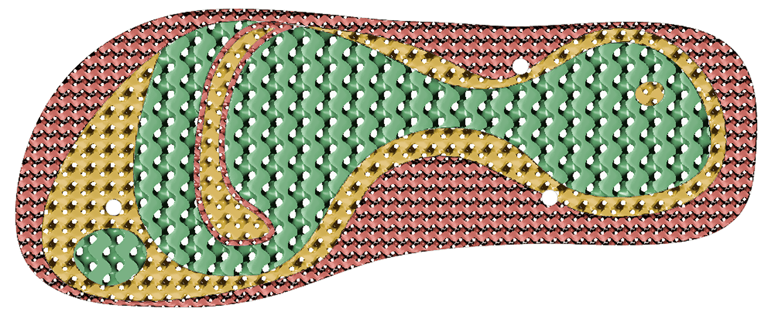
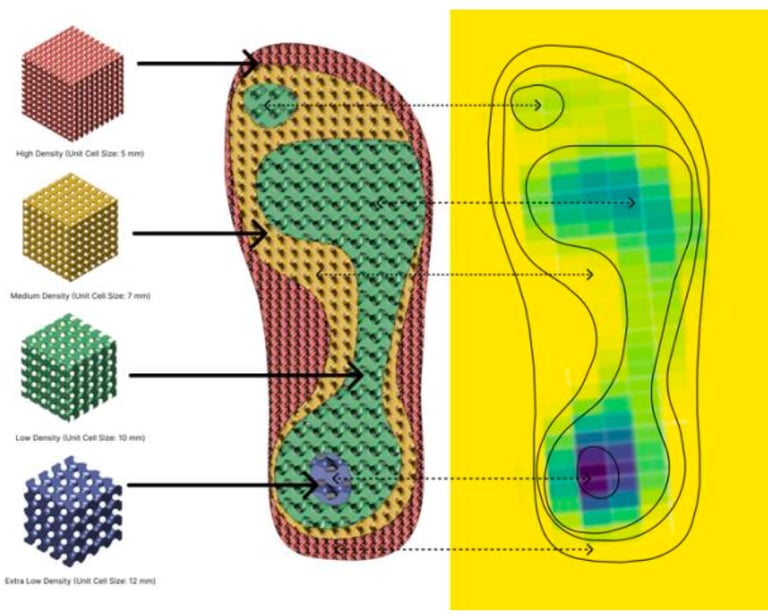
The custom lattice gradient, derived from pressure map data, forms the midsole structure. In areas of higher pressure, the lattice features lower density mesh for supportive cushioning, redistributing plantar pressure to outer regions. Incorporating a mesh midsole disperses plantar pressure over a larger surface area compared to solid surfaces, reducing localised pressure points. All mesh densities offer adequate support, preventing "bottoming out" leading to prolonged comfort and performance. The latticed midsole creates channels for heat dissipation and drainage, while enhancing shoe flexibility and minimising material usage.
Lattice Distribution
Design Proposal
Note: Full project details are outlined in the project report.
Insole
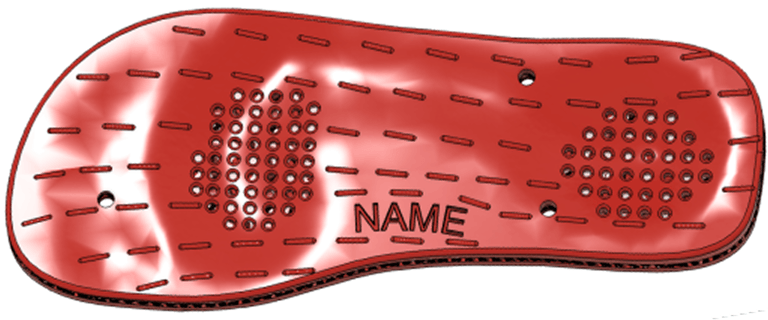
The insole is biomechanically customised to the user’s foot, reducing stress and improving comfort compared to flat sole flip flops. Raised markings prevent slipping even when wet, while drainage channels in the deepest imprint areas enhance ventilation and reduce the risk of infections. Extending the flip flop beyond the toes allows natural toe movement, supporting balance and proper foot alignment. The user’s name can be embossed in a non-contact area, meeting the design objective of personalisation.
Midsole
The midsole incorporates a latticed structure based on pressure mapping to optimise cushioning and support. Using a triple periodic minimal surface (TPMS) gyroid unit cell, the lattice provides flexibility, shock absorption, and airflow, while redistributing plantar pressure to minimise localised stress points. This design enhances comfort, allows natural foot movement, reduces material usage and facilitates drying and ventilation. The lattice is optimised for additive manufacturing, enabling mass customisation and high geometric complexity at low cost.
Outsole
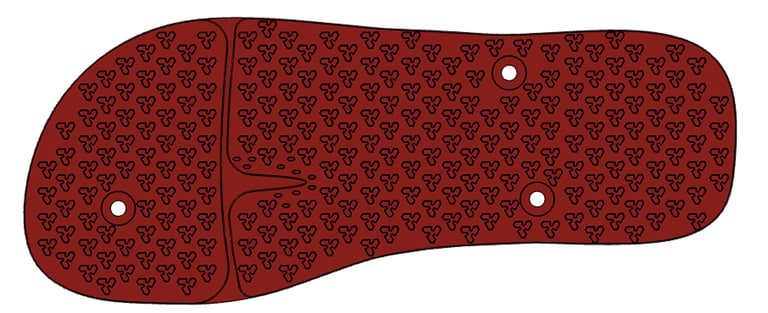
The outsole combines anti-slip grip patterns and flexible segmentation to support agility and natural gait. Manufactured in bright red for visibility, the outsole is designed to resist wear, chemicals, and UV exposure. Wide nylon straps provide durable, hydrophobic, and elastic support, reducing the risk of foot fatigue and injuries. The three layers are designed for consolidation into a single SLS-printed part, minimising assembly time, material waste and ensuring consistent structural performance while maintaining comfort, safety and hygiene for lifeguards.