Tandem Bicycle
FEA Engineering Analysis | 2023
About
This project aims to design a tandem bike suitable for two adults each weighing 100kg. The bike must becomfortable to ride, which has been defined as a bike frame with a natural frequency greater than 30Hz.
Additionally, the frame must have an effective life of at least 10 years (= one million loading cycles). Two frame designs will be investigated alongside the use of two different materials (aluminium and titanium) to design a lightweight frame with an optimised natural frequency and fatigue life.
Note: Full project details are outlined in the report; a summary is provided below.
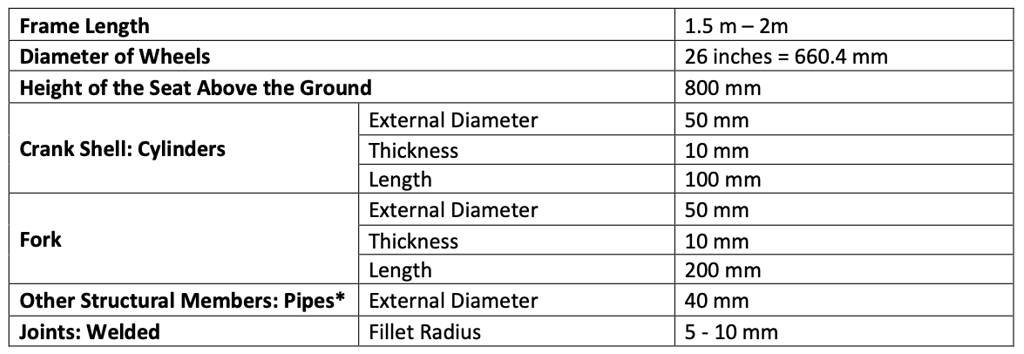
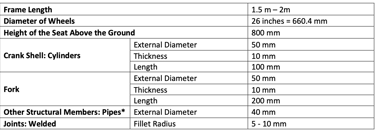
Dimensional Limitations Outlined in the Brief
Material Analysis
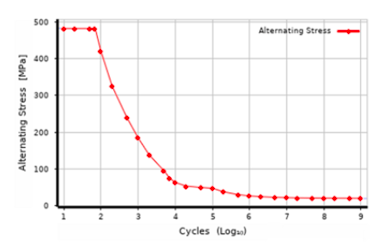
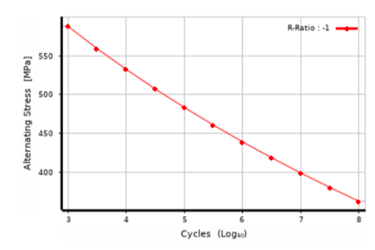
6061 Aluminium Alloy was chosen due to its favourable strength, toughness and machining properties which makes it common in bike frames. The material is available in Ansys however, the SN data is limited, and so external data was sourced and used instead.
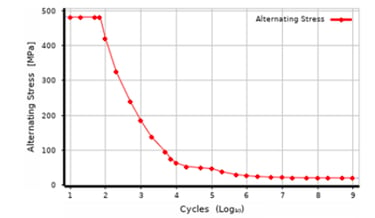
Ti-3Al-2.5V was considered the optimum titanium alloy as it is the most common composition for bike frames and has a high fatigue strength. The Ansys SN curve was used despite it being limited as alternative data could not be easily sourced.
Boundary Conditions
Weight of Two Adult Cyclists
Oscillating Load on the Pedals
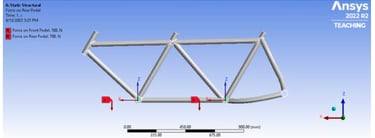
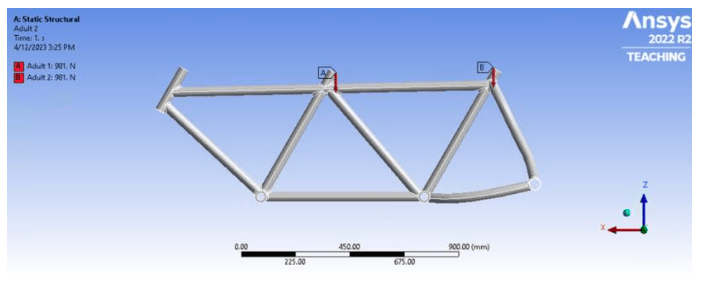
The mass of each cyclist was assumed to be 100kg (= 981N). Multiplying the mass by 9.81 m/s2 removes the additional need to model gravity. The force was applied to the top surface of each of the seat tubes and acts downwards perpendicular to the ground. This loading condition assumes maximum force exertion which occurs when the bike is freewheeling i.e., no downwards force is exerted onto the pedals.
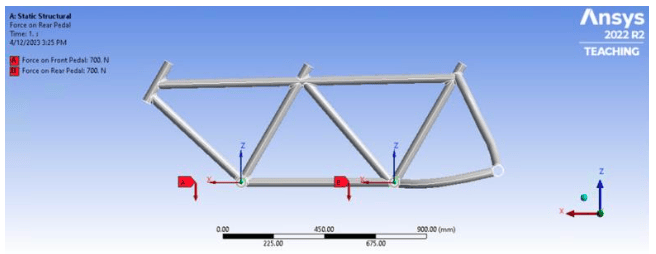
Each pedal experiences a force ranging from 0 to 700 N. Since the pedals were not included in the CAD model, a coordinate system was defined at each crank shell and the 700 N force was applied downward at a displacement point 200 mm along the x-axis and 100 mm along the y-axis. Both forces were applied to the same side of the frame to represent the worst-case scenario, making the model asymmetrical and preventing simplifications. The pedals are connected so that when one experiences maximum stress the other experiences minimum stress with the forces always summing to 700 N throughout the pedalling cycle.
Analysis of First Design
Natural Frequency
Fatigue Life
Aluminium
Titanium
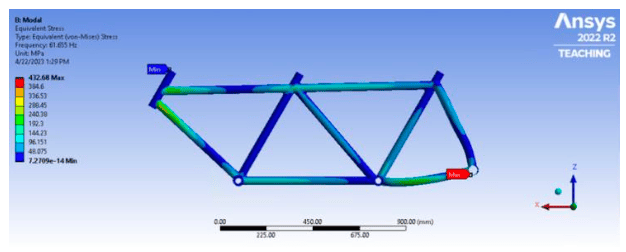
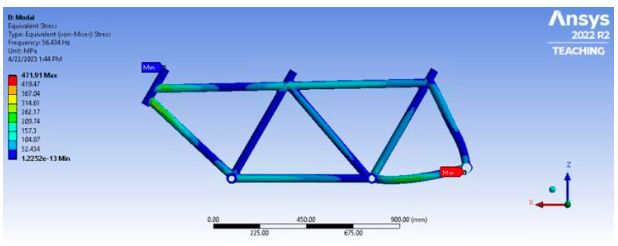
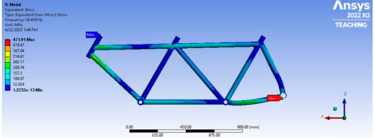
Design 1 in both aluminium and titanium successfully achieves a natural frequency >30Hz. The natural frequency of the aluminium frame is 8.5% higher than that of titanium.
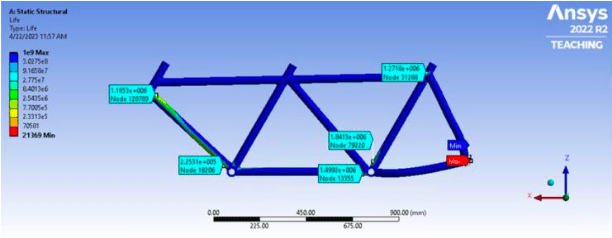
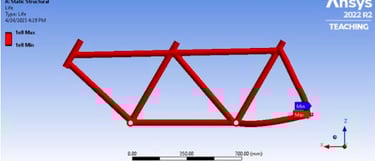
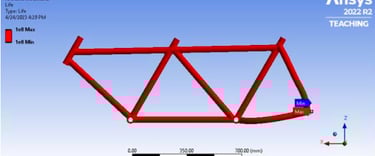
Likely areas of premature failure (<10^6 loading cycles) of the aluminium frame include the downtube and dropouts. All other areas are predicted to exceed the lifespan. The same life is predicted throughout the whole of Design 1 in titanium. 1e8 is the last piece of data available in the Ansys SN-curve. This result therefore predicts that the actual life is > 1e8 cycles.
Aluminium
Titanium
Analysis of Refined Design
Natural Frequency
Fatigue Life
Aluminium
Titanium
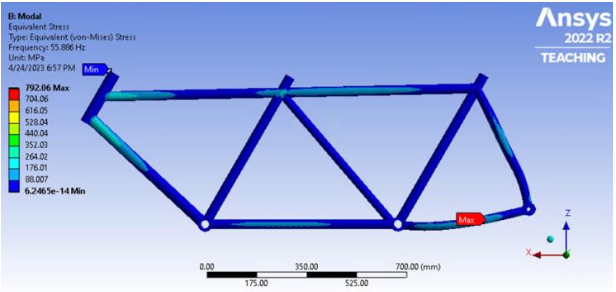
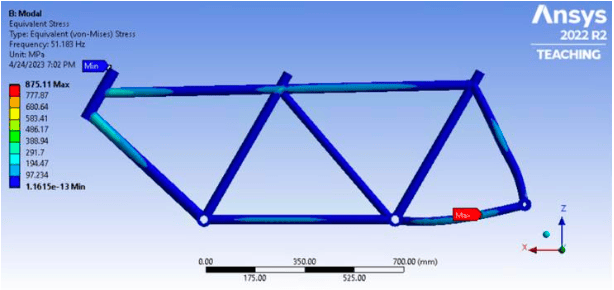
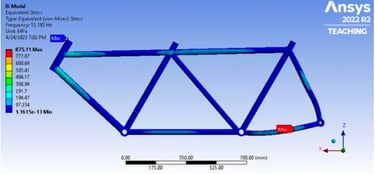
Natural frequency is inversely proportional to mass (𝑓 = (1/(2𝜋)) √(𝑘/𝑚)) . The slight decrease in the frame’s mass leads to an increase in the natural frequency however, this was overshadowed by a decrease caused by altering the geometry. The frequency minimum threshold is still exceeded for both materials.
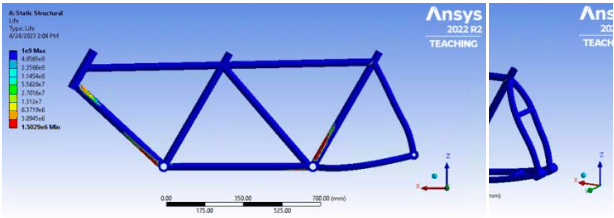
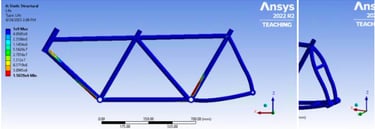
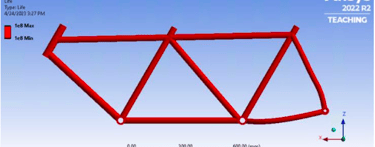
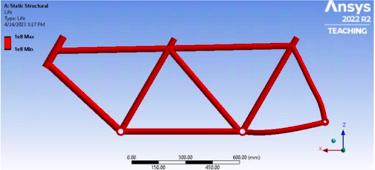
Areas in Design 1 with an expected life <10^6 cycles were reinforced in the refined Design. This led to all areas meeting the criteria.
Aluminium
Titanium
Overall Findings


The refined design successfully meets all of the brief’s criteria. The aluminium version is significantly lower in mass and has a higher natural frequency however, if the titanium frame was scaled according to its relative strength compared to aluminium, then far less material would need to be used. This would lead to a decrease in mass and thus a desirable increase in natural frequency.
The refined design in aluminium would be selected as the optimal tandem frame. The requirement of the brief relates to mass, natural frequency, and fatigue life. Both designs pass the natural frequency criteria and although, the fatigue life of the titanium frames is higher than that of aluminium, the lower mass will be prioritised for the lightweight tandem criteria.